The Post-Equatorial Trilogy
Six years after a pathogen kills nearly everyone, the survivors are left with what was always the harder problem — not how to stay alive, but what to do with the life that remains.
"Where the Voices Were is post-apocalyptic fiction stripped of everything that makes the genre comfortable. There are no action set pieces, no villains to defeat, no cavalry arriving. There is only Adam — methodical, self-contained, and utterly alone. Hargrove builds the collapse with the precision of an engineer: the empty waiting rooms, the cars with drivers still buckled in, the infrastructure that held a few days longer than the people who ran it. Readers willing to slow down will find a novel that takes survival seriously — not as spectacle, but as the daily, unglamorous work of staying alive and remaining human while doing it."
— Editorial Review
From the Author
I spent many years writing code. Precise, logical, consequential — if you got it wrong, something broke and you found out immediately. Fiction, I assumed, would be different.
It wasn't, really.
Where the Voices Were started with a question I couldn't shake: if nearly everyone died, what would the first few years actually look like? Not the drama of the collapse, but the dailiness of what came after — the inventory, the maintenance, the particular loneliness of a world where there's no one left to notice whether you succeed or fail.
Adam is not a hero in any conventional sense. He's methodical, self-reliant, and deeply alone. The story follows him from the first realization of what has happened, through years of solitary survival, to the moment he sees smoke on a hillside and has to decide what to do about it.
I wanted the world to be accurate enough to hold up — the geography, the logistics of surviving without infrastructure, the way nature reclaims things faster than you'd expect. I also wanted it to be honest about what isolation does to a person over time. Not dramatic. Cumulative.
This book was written in collaboration with an AI — something I disclose in the book itself. The story is mine. The process was unusual. I found it worth it.
It's the first book of the Post-Equatorial Trilogy. The second is The Remedy. The third is Threshold.
— Ron Hargrove, McKinney, Texas
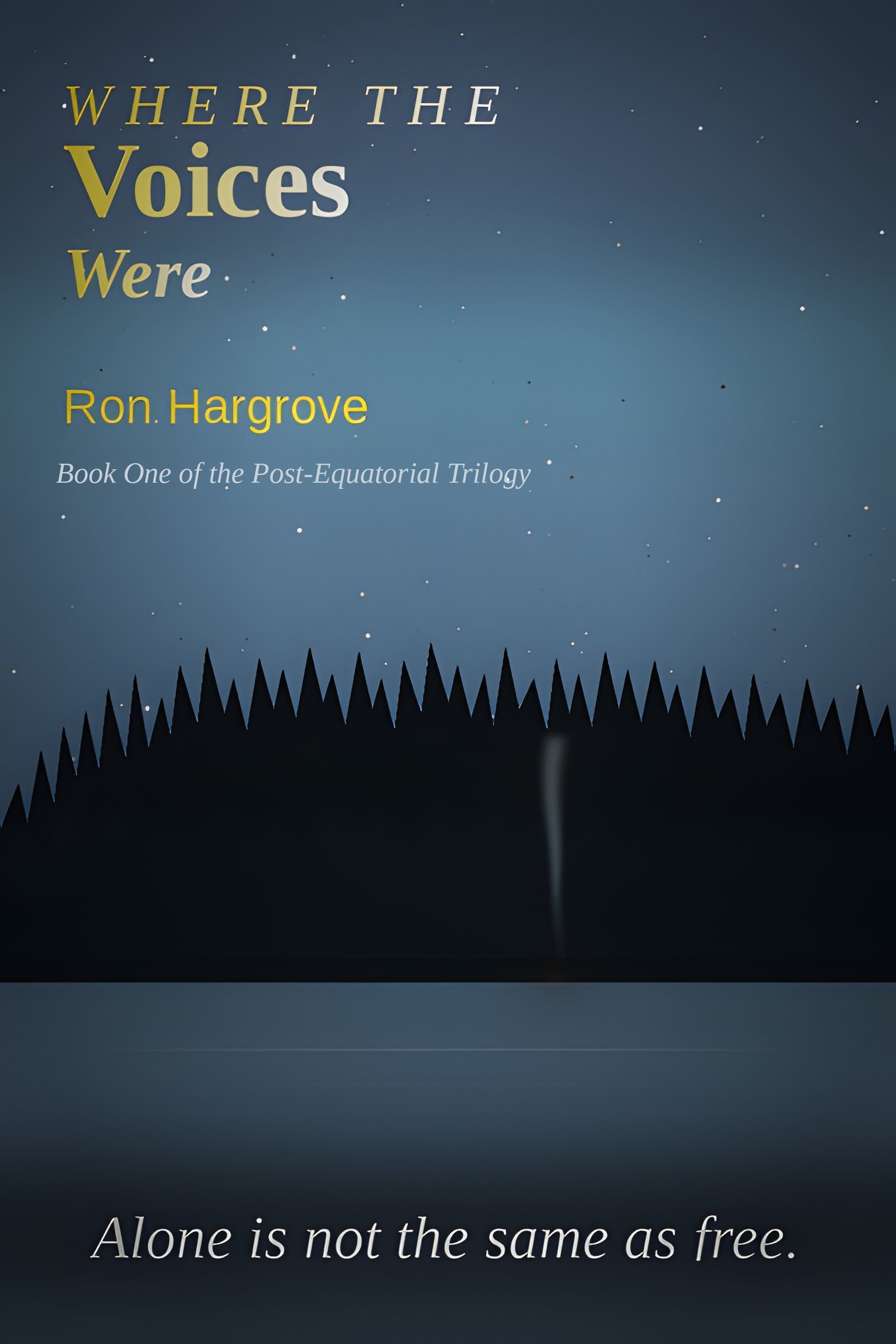
Where the Voices Were
Book One of the Post-Equatorial Trilogy
The world didn't go dark all at once. It went quiet.
A fast-moving airborne virus sweeps the globe in days, leaving environmental engineer Adam Nolan stranded alone at a remote Arctic diamond mine. When the radios stop answering and no plane returns, he drives south — through empty highways and leveled cities — carrying the weight of a world that no longer needs him.
What follows is not an adventure. It is something quieter and more demanding: one man rebuilding a life from first principles. Fuel degrades. Generators fail. Wildlife reclaims the suburbs. Adam sources water, constructs systems meant to last, and confronts the question that survival alone cannot answer — what does it mean to keep going when there is no one left to go on for?
Then he sees smoke on a hillside.
Where the Voices Were is a novel about competence, loneliness, and the precise moment a person decides that another human being is worth the risk. Methodically researched and quietly devastating, it asks whether survival and meaning are ever really the same thing.
The first book of the Post-Equatorial Trilogy. For readers of The Road and I Am Legend.
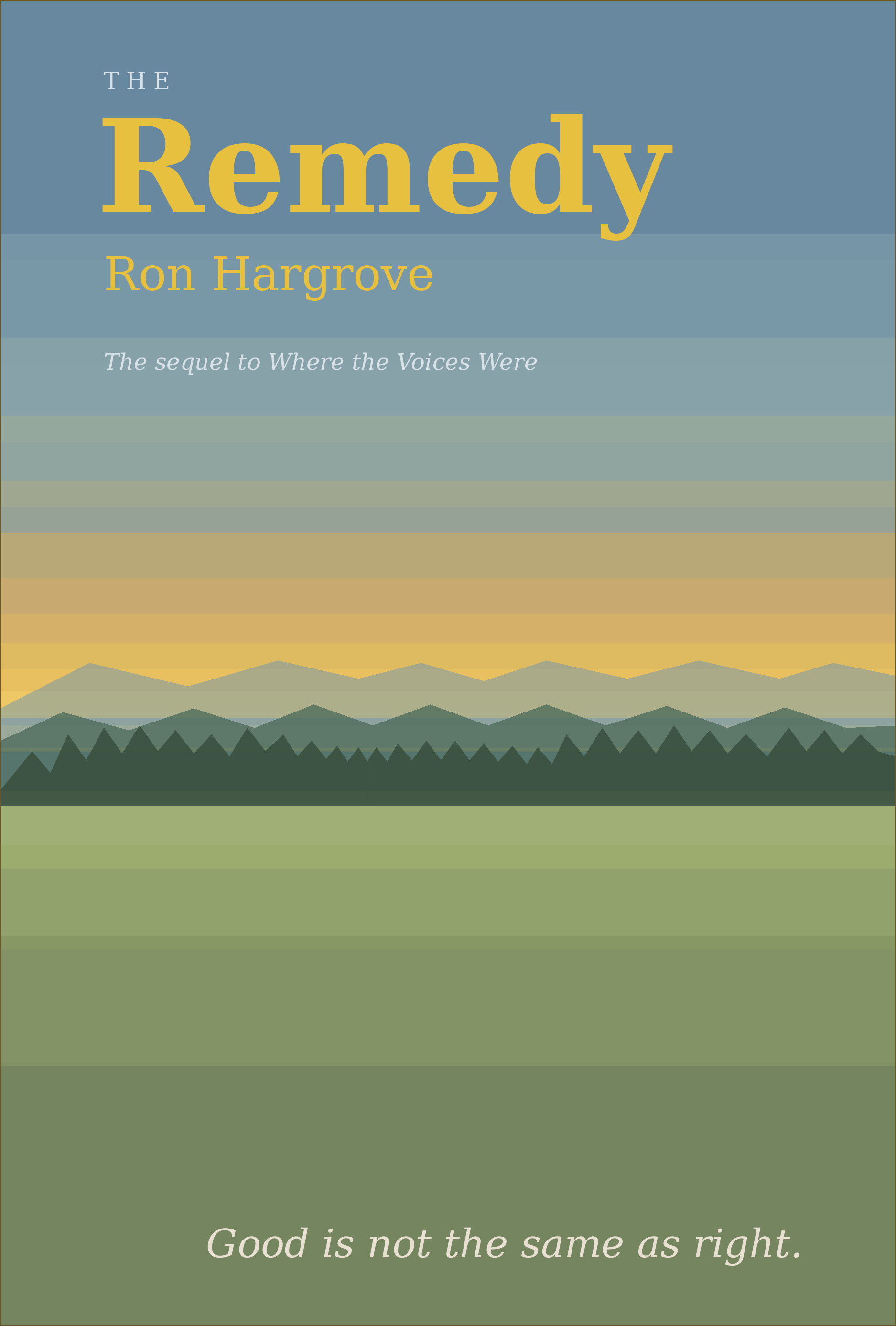
The Remedy
Book Two of the Post-Equatorial Trilogy
Six years of silence. Then smoke on the horizon.
Adam Nolan has built what works — shelter, food, water, a horse he trusts. He has stopped expecting the world to surprise him.
Then he sees the smoke.
Claire Voss arrives with a past she is not ready to share: a community of survivors, a husband who followed her south, and a secret that reframes everything Adam thought he understood about why anyone survived at all. The virus was not an accident. Three communities were vaccinated without their knowledge, by a man who spent years preparing for a world he knew was coming.
What Adam and Claire do with that knowledge — and what it costs them — is the heart of the book.
The second book of the Post-Equatorial Trilogy. For readers of Station Eleven and The Dog Stars.
"The Remedy picks up where survival leaves off. Adam and Claire ride toward a community with a secret at its center — one that will force everyone who lives there to answer a question no legal system ever prepared them for. What follows is one of the most unusual moral dramas in recent post-apocalyptic fiction: formally structured, scrupulously fair, and genuinely unresolved in ways that stay with the reader long after the final vote is cast. Hargrove doesn't resolve the central question. He does something harder — he assembles a community of ordinary people and asks them to live inside it."
— Editorial Review
From the Author
The question at the center of The Remedy is one I couldn't resolve, and I didn't try to.
Adam arrives at Claire's community carrying information its founder has never been asked to account for. What he doesn't anticipate is how hard the question becomes when the people who have to answer it are the ones most affected by the answer.
The reckoning that occupies the novel's second half was hard to write. I wanted it to be fair — to everyone in that room. I wanted the people sitting with an impossible arithmetic to be real enough that their responses felt earned.
That was the goal. Whether it was achieved is for the reader to decide.
The second book of the Post-Equatorial Trilogy. The first is Where the Voices Were. The third is Threshold.
— Ron Hargrove, McKinney, Texas
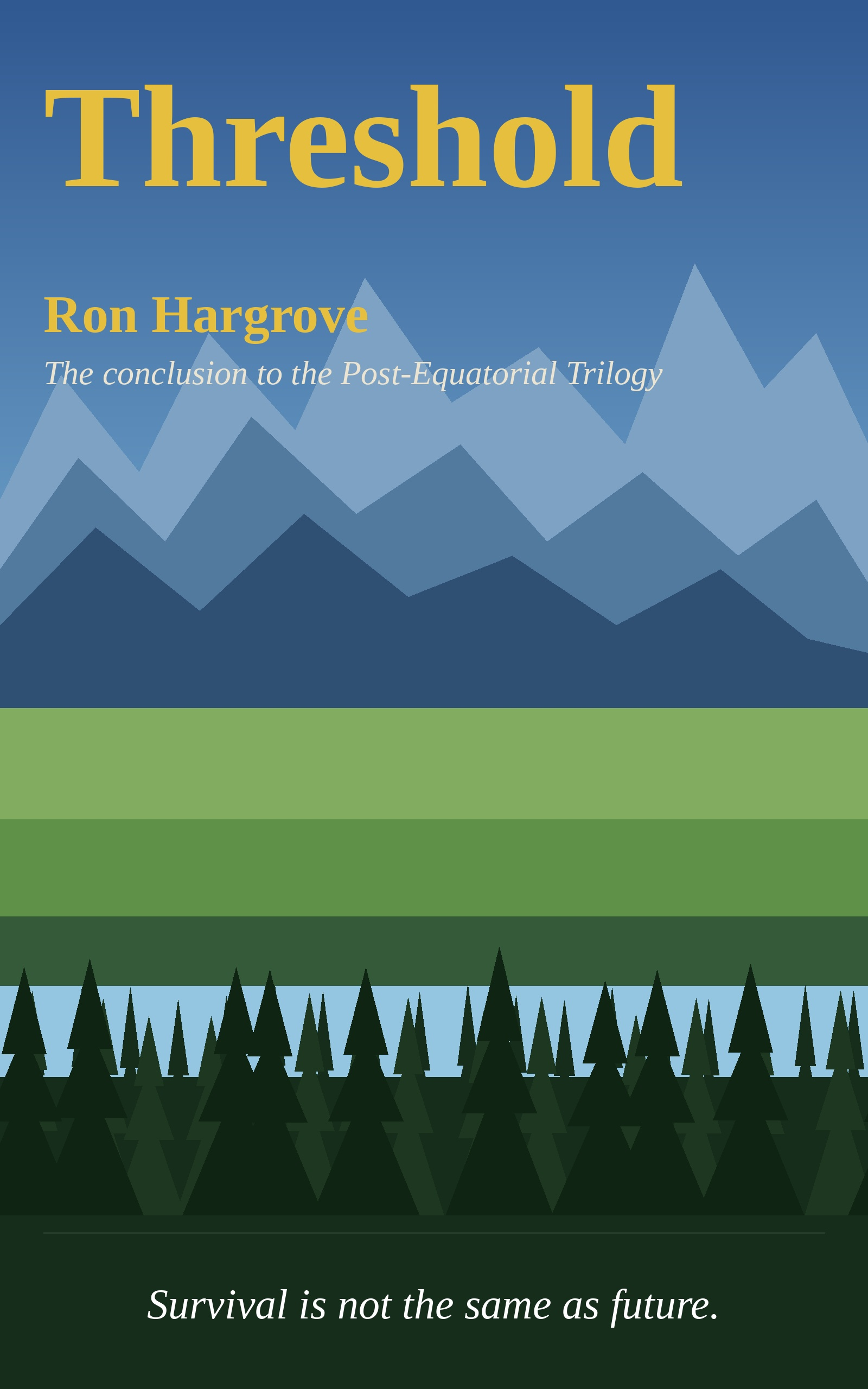
Threshold
Book Three of the Post-Equatorial Trilogy
The communities are dying.
Not today. Not soon. But the math is unforgiving — three communities, each below the population threshold needed for long-term genetic viability, each shrinking toward an end that no one planned and no one can prevent alone.
Adam Nolan spent six years surviving alone before he found people worth protecting. Now he has to tell three communities that what they've built isn't enough — and that survival requires giving it up.
The consolidation plan is straightforward. The logistics are not. Three communities in three different places, each with its own infrastructure, its own leadership, and its own reasons to stay. Adam and Claire spend the next three years making the case, negotiating the terms, and moving four hundred people across what remains of the American West.
Threshold is a novel about the difference between surviving and continuing — and about what it costs to choose, on behalf of people who didn't ask you to, that the answer should be both.
The third and concluding book of the Post-Equatorial Trilogy. For readers of Station Eleven and The Dispossessed.
"Threshold brings the Post-Equatorial Trilogy to a conclusion that is as quietly devastating as it is earned. Where the first book asked what survival looks like and the second asked what justice requires, the third asks the hardest question of all: what are people willing to give up so that something larger than themselves continues? Hargrove answers it with the same precision and moral seriousness that defines the trilogy — without sentimentality, without easy resolution, and without a single wasted page."
— Editorial Review
From the Author
Acting in your own long-term interest is harder than it sounds. Threshold is about people who manage it anyway.
Adam has spent six years surviving — finding shelter, building systems, learning to live in a world that emptied overnight. The third book asks what he's willing to do when continuing that life requires something he didn't anticipate. The answer involves three communities, a long ride, and a series of conversations that are harder than any he's had before.
Ruth is the character I'm most proud of in this book. She's introduced in The Remedy but it's in Threshold that she fully earns her place — a former campaign manager who spent twelve years making an argument the world wasn't ready to hear, and who finds herself, at the end of everything, making it again to a room of a hundred people who have no choice but to listen. The speech she gives might be the best thing in the book.
The third and concluding book of the Post-Equatorial Trilogy. The first is Where the Voices Were. The second is The Remedy.
— Ron Hargrove, McKinney, Texas